
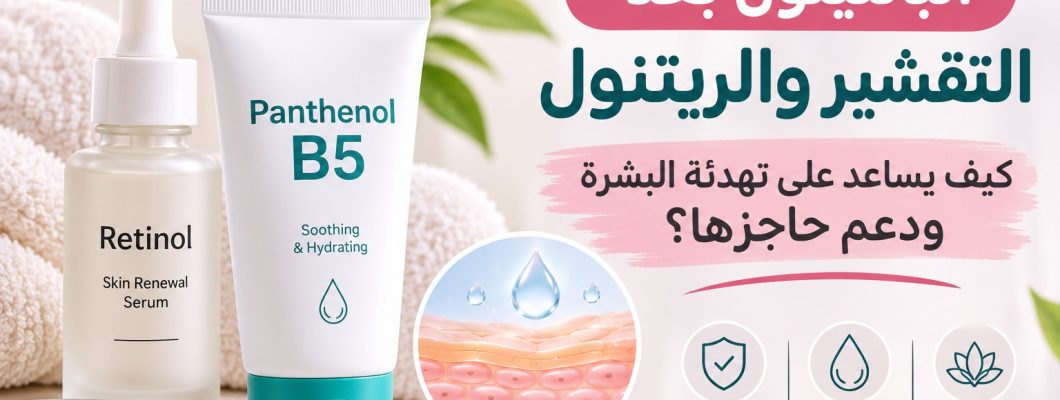
Panthenol After Exfoliation and Retinol: How Does It Help Soothe the Skin and Support the Skin Barrier?
Do you notice dryness, flaking, or a feeling of tightness after using Retinol or exfoliating products? These symptoms may occur when the skin is exposed to active ingredients that accelerate cell renewal or help remove dead skin cells, particularly when they are used at high concentrations or more frequently than the skin can tolerate.
At this stage, keeping the skin hydrated and supporting its barrier function become especially important. This is where Panthenol, also known as Pro-Vitamin B5, comes in. It is commonly included in moisturizing creams and serums because of its hydrating properties and its role in supporting skin barrier function.
But can you use Panthenol immediately after exfoliation? Does it help reduce Retinol-related dryness? And can you apply it alongside Retinol in the same skincare routine?
In this guide from Beauty Ten, we will explore how Panthenol can help care for the skin after exfoliation and Retinol use, how to incorporate it into your skincare routine, and the precautions that can help you avoid irritation.
Why Does Your Skin Need Extra Care After Exfoliation and Retinol?
Exfoliation and Retinol work differently, but both may cause dryness or irritation in some people, particularly when used excessively.
First: What Happens to the Skin After Exfoliation?
Chemical exfoliants, such as Alpha Hydroxy Acids (AHAs) and Beta Hydroxy Acids (BHAs), help remove dead skin cells from the skin's surface. When used appropriately, they may improve skin texture and appearance.
However, frequent use or unsuitable concentrations may lead to:
Skin dryness and a feeling of tightness.
Temporary redness or stinging.
Flaking and roughness in certain areas.
Increased skin sensitivity to some skincare products.
Temporary disruption of skin barrier function due to over-exfoliation.
For this reason, it is important to use a suitable moisturizer after exfoliation and avoid repeating the process before your skin has recovered.
Second: Why Does Retinol Cause Dryness and Peeling?
Retinol is a Vitamin A derivative used in skincare products to improve the appearance of fine lines, uneven skin tone, and certain acne-related concerns.
When you first start using it, your skin may go through an adjustment period known as Retinization. During this stage, you may experience symptoms such as:
Dryness.
Mild peeling.
Redness.
Stinging or sensitivity.
Increased discomfort when using other skincare products.
These symptoms are more likely to occur when using a high concentration, applying Retinol every day from the beginning, or combining it with strong exfoliants without considering your skin's tolerance.
Therefore, irritation does not necessarily mean your skin needs more active ingredients. It may need a simpler routine focused on hydration instead.
How Does Panthenol Help the Skin After Exfoliation and Retinol?
Panthenol is a precursor of Vitamin B5. Once absorbed into the skin, it is converted into pantothenic acid. It is widely used in skincare products because of its moisturizing properties and its role in supporting skin barrier function.
Here are some of its potential benefits during this stage:
1. Improving Skin Hydration and Reducing Dryness
Exfoliation and Retinol use may increase feelings of dryness and tightness. Panthenol can help improve hydration in the outer layer of the skin.
This can make the skin feel softer and more comfortable, especially when Panthenol is included in a suitable moisturizing cream.
2. Supporting the Skin Barrier
The skin barrier is the outermost layer responsible for helping retain moisture and protecting the skin against external factors.
Studies on Dexpanthenol suggest that it can improve certain indicators of skin barrier function, including stratum corneum hydration and reduced transepidermal water loss.
This makes Panthenol a useful ingredient to consider when choosing skincare products designed to support the skin barrier after dryness or irritation.
3. Helping Improve the Appearance of Dryness and Flaking
When the skin loses moisture, it may become rougher and develop small flakes.
Using a Panthenol-containing product as part of a moisturizing routine can help improve skin smoothness and reduce discomfort associated with dryness.
However, it is important to understand that Panthenol does not immediately stop Retinol-related peeling or treat every cause of redness or inflammation.
4. Supporting the Skin During the Retinol Adjustment Period
Using a moisturizer containing Panthenol may be beneficial as part of a Retinol skincare routine because it helps provide hydration and support the skin barrier.
In a clinical study examining the use of a moisturizer containing several vitamins, including Panthenol and Niacinamide, alongside Tretinoin, improving skin barrier function before treatment and continuing moisturizer use helped make the early adjustment period to Tretinoin easier.
It is important to clarify that the study tested a multi-ingredient formulation, so the results cannot be attributed to Panthenol alone.
Can You Use Panthenol Immediately After Exfoliation?
This depends on the type of exfoliation, its intensity, and how your skin feels afterward.
After Mild At-Home Exfoliation
If you use a mild at-home exfoliant, such as Lactic Acid, Glycolic Acid, or Salicylic Acid, and your skin is not experiencing severe burning or redness, a gentle moisturizer containing Panthenol may be suitable after exfoliation.
It is preferable to follow these steps:
Rinse off the exfoliating product according to its instructions.
Use lukewarm water without rubbing your skin.
Gently pat your face dry.
Apply a suitable moisturizer containing Panthenol if its formula feels comfortable on your skin.
Apply sunscreen in the morning.
If you experience noticeable burning or persistent irritation, stop using the exfoliating product rather than trying to cover the problem by applying more skincare products.
After an In-Clinic Chemical Peel
Skincare after an in-clinic chemical peel is different. The appropriate routine depends on the type and depth of the peel and how much the outer skin layer has been affected.
In this situation:
Follow your doctor's instructions regarding which cleansers and moisturizers are allowed.
Do not introduce a new cream or serum without confirming that it is suitable for your current recovery stage.
Avoid Retinol, acids, and exfoliants until your doctor says you can resume using them.
Do not manually remove peeling skin.
Follow your doctor's sun protection instructions.
Panthenol can be a useful ingredient in certain post-peel skincare products. However, this does not mean that every Panthenol-containing product is suitable after a deep chemical peel or when the skin has open or damaged areas.
Can You Use Panthenol with Retinol?
Yes. Panthenol and Retinol can generally be used together in a skincare routine, provided your skin tolerates the formulation and is not experiencing noticeable irritation.
Retinol targets skin renewal and the appearance of certain skin concerns, while Panthenol helps support hydration and skin barrier function.
Method 1: Using Both in the Same Evening Routine
If your skin is already accustomed to Retinol and is not experiencing noticeable irritation, you can follow these steps:
Cleanse your face with a gentle cleanser.
Allow your skin to dry completely.
Apply an appropriate amount of Retinol according to the product instructions.
Follow with a moisturizer containing Panthenol.
This method may suit people whose skin tolerates Retinol and who want to add an extra moisturizing step to their routine.
Method 2: The Retinol Sandwich Method
This method may help some people reduce the feeling of dryness or irritation when using Retinol.
It involves the following steps:
Apply a thin layer of a suitable moisturizer.
Apply Retinol after the moisturizer has been absorbed, following the product instructions.
Apply another layer of moisturizer.
You can choose a moisturizer containing Panthenol for this step. However, the sandwich method is not necessary for everyone, and applying moisturizer before Retinol may affect the absorption of certain formulations. Follow the product instructions or your dermatologist's recommendations.
When Should You Separate Panthenol and Retinol?
There is no general need to separate them simply because both ingredients are being used in the same routine.
However, if your skin is noticeably irritated or peeling, it is better to temporarily stop using Retinol and focus on a simple, gentle routine that includes a suitable cleanser, moisturizer, and sunscreen.
Resume Retinol only after your skin has improved and can tolerate the routine again, following the product instructions or your doctor's advice.
The Best Way to Use Panthenol After Exfoliation and Retinol
You can incorporate Panthenol into a simple skincare routine focused on hydration and reducing potential sources of irritation.
Morning Routine
Use a gentle cleanser, or rinse with water if that is suitable for your skin.
Apply a Panthenol serum if its formula is suitable and does not cause stinging.
Use a gentle moisturizer.
Apply a broad-spectrum sunscreen with SPF 30 or higher.
Evening Routine
Gently remove makeup and sunscreen.
Cleanse your skin with a gentle cleanser.
Apply a Panthenol cream or a moisturizer containing Panthenol.
Temporarily avoid exfoliants and Retinol if your skin is irritated.
Note:<> Tired or irritated skin does not need a long skincare routine. During periods of dryness and irritation, reducing the number of products may be more helpful than adding several new serums and creams.
Best Panthenol Products at Beauty Ten for Skin Care After Exfoliation and Retinol
When choosing a product containing Panthenol, it is important to look beyond the ingredient name or its concentration. Consider the product type, texture, complete formulation, and how well it suits your skin's current condition.
1. Purito Seoul Mighty Bamboo Panthenol Cream
Purito Seoul Mighty Bamboo Panthenol Cream<> contains Panthenol and Bamboo Extract. It is used as a moisturizing step in facial skincare.
It can be considered as part of a routine focused on hydration and skin barrier support, especially when experiencing dryness or tightness after using active ingredients.
Why Consider This Product?
Contains Panthenol.
Includes Bamboo Extract.
Suitable as a moisturizing step in a skincare routine.
Can be used according to the product instructions and your skin's tolerance of its formula.
Discover Purito Seoul Mighty Bamboo Panthenol Cream at Beauty Ten
2. AXIS-Y Panthenol 10 Skin Smoothing Shield Cream
AXIS-Y Panthenol 10 Skin Smoothing Shield Cream contains 10% Panthenol, according to the product information, along with other ingredients such as TECA and Beta-Sitosterol.
It may be an option for those looking for a cream focused on hydration and skin barrier support as part of their daily routine.
Key Features:
Contains 10% Panthenol.
Includes additional ingredients that support skincare.
Can be incorporated as a moisturizing step according to the product instructions.
It is advisable to patch-test the product first, especially if you have sensitive skin.
Discover AXIS-Y Panthenol 10 Cream at Beauty Ten
3. Epii Double Up Cream with Ectoin and Panthenol
Epii Double Up Cream<> combines Ectoin and Panthenol, two ingredients used in skincare formulations designed to provide hydration and support the skin barrier.
It may suit those who prefer a moisturizing cream that combines more than one skin-supporting ingredient.
Discover Epii Double Up Cream at Beauty Ten
Important Note: These products are options for moisturizing and supporting the skin barrier. They are not medical treatments for chemical peel burns, inflammation, or severe irritation. After an in-clinic peel, use only products approved by your doctor.
Common Mistakes to Avoid When Using Panthenol After Exfoliation and Retinol
To benefit from your moisturizing routine without increasing irritation, avoid the following mistakes:
Using Retinol and exfoliating acids on the same night: Combining several active ingredients may increase the likelihood of dryness and irritation.
Exfoliating already peeling skin: Do not try to remove flakes by using another exfoliant or scrubbing your face.
Using too many products at once: This can make it difficult to identify which ingredient is causing irritation.
Relying on Panthenol alone: Skin barrier support requires a balanced routine that includes gentle cleansing, moisturizing, and sun protection.
Choosing a product based only on its Panthenol percentage: The complete formulation and your skin's tolerance are more important than the concentration alone.
Returning to active ingredients too quickly: Wait until your skin has calmed down and recovered, and follow your doctor's instructions after an in-clinic peel.
When Should You Stop Using Retinol or Exfoliants and Consult a Dermatologist?
Mild dryness or limited peeling may be part of the adjustment period when using certain skincare products. However, some symptoms should not be ignored, including:
Severe or persistent burning.
Increasing redness or noticeable swelling.
Pain or painful cracks.
Blisters or discharge.
Severe peeling or open areas of skin.
Irritation that continues despite stopping the product.
If these symptoms occur, stop using the product that may be causing the reaction and seek medical advice, especially if the symptoms develop after an in-clinic chemical peel.
Frequently Asked Questions About Panthenol After Exfoliation and Retinol
Can You Apply Panthenol Cream After Exfoliation?
Some creams containing Panthenol can be used after mild at-home exfoliation if your skin tolerates them and there are no signs of severe irritation. After an in-clinic peel, however, you should follow your doctor's instructions and use only approved products.
Does Panthenol Reduce Retinol-Related Peeling?
Panthenol may help improve hydration and reduce the feeling of dryness and roughness associated with Retinol use. However, it does not immediately stop the peeling process or guarantee that irritation will not occur.
Should You Apply Panthenol Before or After Retinol?
You can use Panthenol in a moisturizer after applying Retinol, or before Retinol as part of the sandwich method. The best approach depends on the product formulations and how well your skin tolerates them.
Can You Use Panthenol with Exfoliating Acids?
Panthenol can be included in a skincare routine that contains exfoliating acids, but it is best to avoid introducing too many active products at the same time. Use the exfoliant according to its instructions, then follow with a gentle moisturizer if your skin tolerates it.
How Often Should You Use Panthenol After Exfoliation?
This depends on the product type, its instructions, and your skin's condition. Some moisturizing creams can be used once or twice daily. After an in-clinic peel, however, you should follow the skincare schedule provided by your doctor.
Is Panthenol Suitable for Sensitive Skin After Retinol?
Panthenol may suit some types of sensitive skin because of its moisturizing properties. However, you should pay attention to the other ingredients in the product. If it causes stinging or persistent redness, stop using it.
Can You Use Panthenol After a Deep Chemical Peel?
You should not independently choose a cream after a deep chemical peel. Your skin requires specific medical care during the recovery period, and you should use only the products recommended by your doctor.
Conclusion: Is Panthenol an Important Step After Exfoliation and Retinol?
Panthenol can be a useful addition to your skincare routine after using Retinol or exfoliating products, thanks to its moisturizing properties and its role in supporting skin barrier function.
It may help improve skin hydration and reduce feelings of dryness and tightness. However, it is not an immediate treatment for irritation, and it does not replace stopping a product that is causing a reaction or following your doctor's instructions after an in-clinic peel.
If you use Retinol or exfoliating products, aim for a balance between active ingredients and hydration, and choose gentle skincare products that suit your skin's needs.
Explore the Panthenol products available at Beauty Ten and choose the option that best fits your skincare routine and helps support your skin barrier.
Leave a Comment